
Medusa – Part III: The Final Transformation
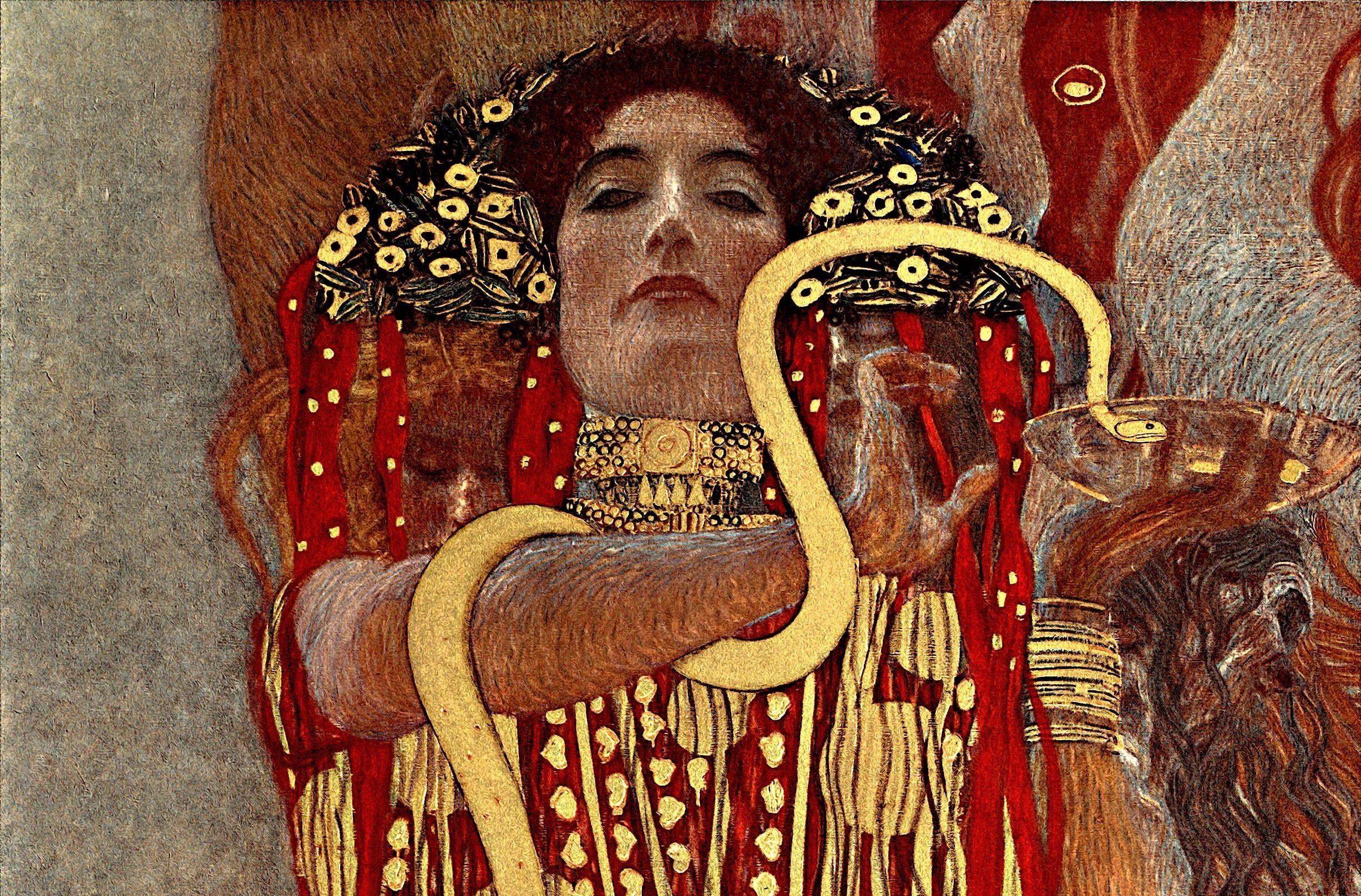
Gustav Klimt’s Hygieia, which borrows heavily from Medusa imagery. Source: Wikimedia Commons
In the Petrie and Pettigrew series, Flinders redecorates the flat at the conclusion of a major case. His redecorations parallel changes in the art world. Pettigrew is generally nonplussed, but usually goes along with the new look—except once.
In Return of the Jinn, the detectives had just entered the dining room to a late dinner of steaming mutton stew.
Pettigrew sat down and picked up a spoon. He was about to ladle some stew when he stared at the spoon. “Flinders. I am holding an unclothed woman with hair down to her buttocks.”
“Beautiful, isn’t she.”
“So, this means that my spoon is going to look like a woman with long, curly hair?”
“It will improve your appetite.”
“No, I just want a spoon that looks like a spoon.”
The man responsible for Pettigrew’s chagrin was Czech painter Alphonse Mucha and his Art Nouveau costume designs for Sarah Bernhardt’s role as Cleopatra. The costume drew upon the Medusa image, with its flowing gown, intricate designs, and long hairstyle. Bernhardt wore the famous snake bracelet to complete the look. Medusa’s snaky locks were transformed into flower-adorned curls, and Mucha’s posters of Bernhardt popularized the Medusa look.
Other artists followed.
Gustav Klimt used the new Medusa image in his painting of Hygieia, Greek goddess of health, a complete transformation from monster to patron of medicine.
Pettigrew gets Flinders to replace the spoon and to bring back his Medusa-stemmed crystal—essentially replacing one Medusa with another.
The crystal that Pettigrew was so fond of was designed by René Lalique, who used the Medusa image in his jewelry and “Barr” pattern glassware, named after an ancient town in Alsace. It’s rare, but you can find some pieces for sale online.
Like Mucha, Lalique also designed for Bernhardt; he created the Medusa headdress in 1895 and produced a line of Medusa broaches and pendants beginning in 1900.
And there you have it: The monster of Greek mythology becomes the symbol of the eternal feminine and the seductive exoticism of the natural world.
When Pettigrew or Flinders passed under the Bernhardt playbill in the hall on their way to sip cognac out of Lalique’s crystal, they were recognizing another world of feminine power, a fresh and unusual concept in the world of oppressive fathers and domineering husbands they lived in.
But the issue of a horrible wrong done to an innocent woman a millennium ago remains. Flinders and Pettigrew did not have to wrestle with it in their era. It took two wars, a social revolution, and a trial about casting couches to bring it up again.
Any comments?

