
The Call of the Bugle – Part III: “Billy, get up, get up and blow another charge.”
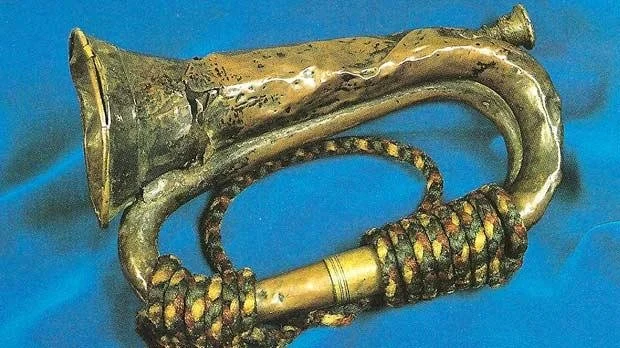
The bugle heard by British cavalrymen as they thundered into Russian gunfire during the Charge of the Light Brigade. Photo: LD Communications/PA Wire
A grizzled sergeant from the 17th bends over the bed of a fallen trumpeter and pleads with him to survive. The pleas were hopeless; the wounds were too severe for Victorian medicine to cure. The trumpeter died.
But the question remained: Who blew the bugle, and where is it now? The answer took a little over 100 years to find.
Two bugles were recovered from the battlefield at Balaclava. One was in good condition, the other dented with a jagged tear along its barrel. Who blew which for the final charge? Like almost everything else about the charge, there was instant and enduring controversy. This one was finally settled in time for a dramatic auction in 1964.
Two candidates for trumpeter emerged: Trumpet Major William Brittain and Trumpet Major Henry Joy. Both were there and took part in the charge; both were put forward by families and supporters. After years of searching through records, letters, wills, and even headstones, experts from Sotheby’s determined that Brittain blew the bugle for the Light Brigade, and Joy bugled for Lord Lucan’s Heavy Brigade that followed it in the charge.
So what happened?
Brittain blew the charge and then was severely wounded, his horse shot from beneath him. In the skirmish that followed the breach of the Russian lines, a Russian lancer rode up to the fallen trumpeter and speared the bugle. He couldn’t pick it up, because its cord was tied around Brittain’s neck. British Lancers rescued Brittian and carried him and the bugle off the field. There is an NPR podcast episode featuring historian Terry Brighton that lays out the story, which you can listen to HERE.
Brittain was taken to Florence Nightingale’s field hospital at Scutari; he survived only a few months. Here is a letter from his nurse describing his last days.
“The trumpeter that sounded the charge for Lord Cardigan is a most pitiful case; he begged that his bugle not be taken out of his sight. Cardigan spent half an hour with him, soothing him. He is lying in some plank beds and blankets. He belongs to the 17th Lancers. His name is Brittain. The sergeant of the 17th calls him Billy and keeps telling him to pluck up and get out and blow another charge, but there was never any hope.”
The image of Lord Cardigan, a man not known for compassion, soothing his old bugler is compelling, as is that of the grizzled sergeant exhorting Billy to “get up, get up,” all the while knowing it was hopeless.
Heart rending.
The nurse, Nurse Ferrall, was probably one of a group of Irish nurses who volunteered to work at Scutari with Nightingale. She and other nurses worked long hours under brutal conditions to save the wounded. Her letter and others from Scutari are in various collections. Taken together, they paint a picture of the anguish of the Crimea.
The charge of the Light Brigade and its aftermath is usually depicted as a male thing, but it is not. The women who worked in the field hospitals gave as much, working night and day, trying to do the impossible—to save men dying of wounds and cholera with only primitive medical resources.
The men of the 17th watched their comrades die on the field of battle; the nurses of Scutari watched them die in “plank beds and blankets.”
Brittain died from his wounds, and the bugle passed to his family. They, in turn, sold it for two pounds to the owner of the Percy Arms in Dublin, where it hung over the pub’s bar for the next 60 years. The bugle was put up at auction in 1964, after its provenance was determined. Ed Sullivan—yes, you heard right, the Ed Sullivan—and actor Laurence Harvey bought it for less than $2,000 after 55 seconds of bidding.
Unbelievable.
Sullivan repaired the bugle and donated it to the Queen’s Royal Lancers Museum, where it is still displayed. The donation took place on The Ed Sullivan Show. Harvey read Tennyson’s poem, and a lancer from the 17th received the bugle. You can watch a clip HERE and check out the museum’s website HERE.
However, that doesn’t end things. The Museum allowed the bugle to be played at the British Military Tournament of 2011. There is also a story that it appeared on Antiques Roadshow in 2013, but it was probably a different bugle. Presumably, the Balaclava bugle will be played again depending on the occasion.
In 2015, Lara Kriegel wrote a trenchant piece on the commercialization of the bugle and survivors’ experiences. She lamented the fact that survivors sold their stories for profit and that the bugle became a TV extravaganza. Beneath her pristine logic was a moral statement: What happened that morning in 1854 was too profound to be the subject of the banalities of the marketplace, political or commercial.
I agree.
But there is another side. Great events always seem to create moral ambiguities. Speaking before another battle, Henry V put it this way:
“He that outlives this day and comes safe home,
will stand a tip toe when this day is named… Then
he will strip his sleeve and show his scars … Old men
forget… But he will remember with advantages what
feats he did that day…”
So if a man charged down the Valley of Death and lived to tell about it, why shouldn’t he be allowed something for his troubles?
Remember the words, “Half a league, half league, half a league onward…”?
Well, Billy and his bugle started all this.
